Sunday, January 9, 2011

History of TERN

TERN, July 2010

TERN was built by a fellow named Scott Schmidt in the late 1970's.  He dreamt of building his noble craft and taking her offshore, and put incredible energy and love into the boat.  He began construction in Lisbon Oregon, after acquiring the plans from Laurent Giles' firm in England.  While Trekka was built with Western Red Cedar, Scott had found a beautiful supply of Port Orford Cedar (a type of yellow cedar), which had been cherry-picked for boat building because of it's straight grain.  This is a superior material for strength and rot/insect resistance.  Scott followed the plans to a "t" and, after completion, he lived aboard and sailed the waters between Seattle and North Vancouver Island.  From there, his life changed and he sold the boat to someone who sailed her up to Alaska and back.  Years later, the boat changed hands again and a Swiss man named Louis took stewardship of her for the next 15 years.

Phoca at anchor
I first saw the boat when my girlfriend (now wife) and I arrived in the Pacific Northwest after completing a N. Pacific voyage on our Atkin-designed ketch, PHOCA.  Our journey took us from Bellingham, to Southern California, Mexico, Hawaii and back, and we learned a lot about offshore sailing, what works as far as interior layout, equipment and sail inventory.  Anyway, I spotted this lovely sloop at the marina we had arrived at, and went to have a look while we dried our sails.  Immediately I recognized the design as very similar to Trekka, but with a sloop rig instead of yawl. The boat appealed to me in its simplicity and ruggedness, and had a distinct look which I liked. Other aspects of the design were almost identical.

A few years went by during which we sold our ketch "Phoca", bought some land, and created a simple, beautiful homestead.   As life got more comfortable on our property, and the list of projects shrank to a fraction of what it had been for years, I again heard the siren call of another boat, and sailing.

I found out who owned the sloop (then called Dragonfly) and gave him a call.  Louis met me at the boat and I got to see belowdecks for the first time.  It was like  a wooden gem inside.  As I looked at the way things had been designed, built and maintained, I knew that this was a vessel I wanted to sail and own, and put my own energy into.  A deal was struck, and I took ownership of her.

Since then, I have sailed the boat a lot, and have made many upgrades and improvements to ready her for the true ocean.  I also re-named her  "TERN".  I just couldn't accept having  a boat named for an insect out on the ocean.  Usually, when you see insects on the ocean, they are like shipwrecked sailors; lost and barely surviving.  A creature like a tern felt much more appropriate-light, buoyant and very much at home on the sea.

The designer, Laurent Giles, is renowned for his beautiful and distinct designs, and the story of how the design came to be is na interesting one.  Essentially, he was hired to help an ambitious (and brave) small-boat sailor, Patrick Ellam, prove a controversial point;  that it is possible to sail offshore in small, well designed craft, and that in some cases, they can be more safe and seaworthy than larger, heavier vessels.  Laurent Giles listened to what Patrick's requirements and ideas were, and came up with "Sopranino".  Sopranino was then sailed often and hard by Patrick and anyone else he could find to be crew.  Eventually, to prove his point, he decided to sail her across the Atlantic, and did so with Colin Maude in 1951.  They co-authored a book about their trip--"Sopranino".
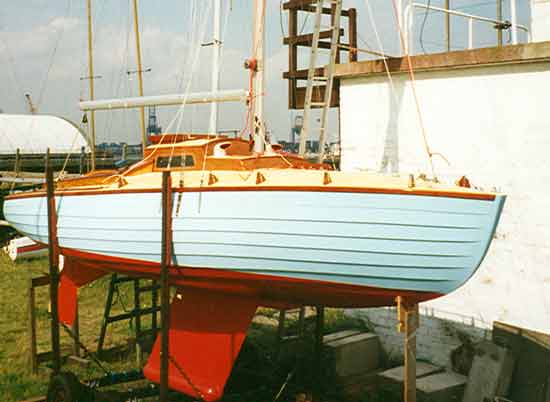
Minim--sistership to Sopranino
From feedback on the design after their 10,000 mile voyage, some minor yet significant changes were made resulting in the Columbia-Class, which is what Laurent designed for John Guzzwell's requirments in yacht:  affordable (small), easy to built (small, and simply-designed), able to carry enough stores for ocean crossings (lot's of volume in the ends), no engine (able, nimble boat).  She became Trekka, and John sailed her around the world, writing a book about it.  The boat changed hands a few times and was sailed around the world again.
John Guzzwell's Trekka

Tuesday, December 28, 2010

Haul-out, summer 2010


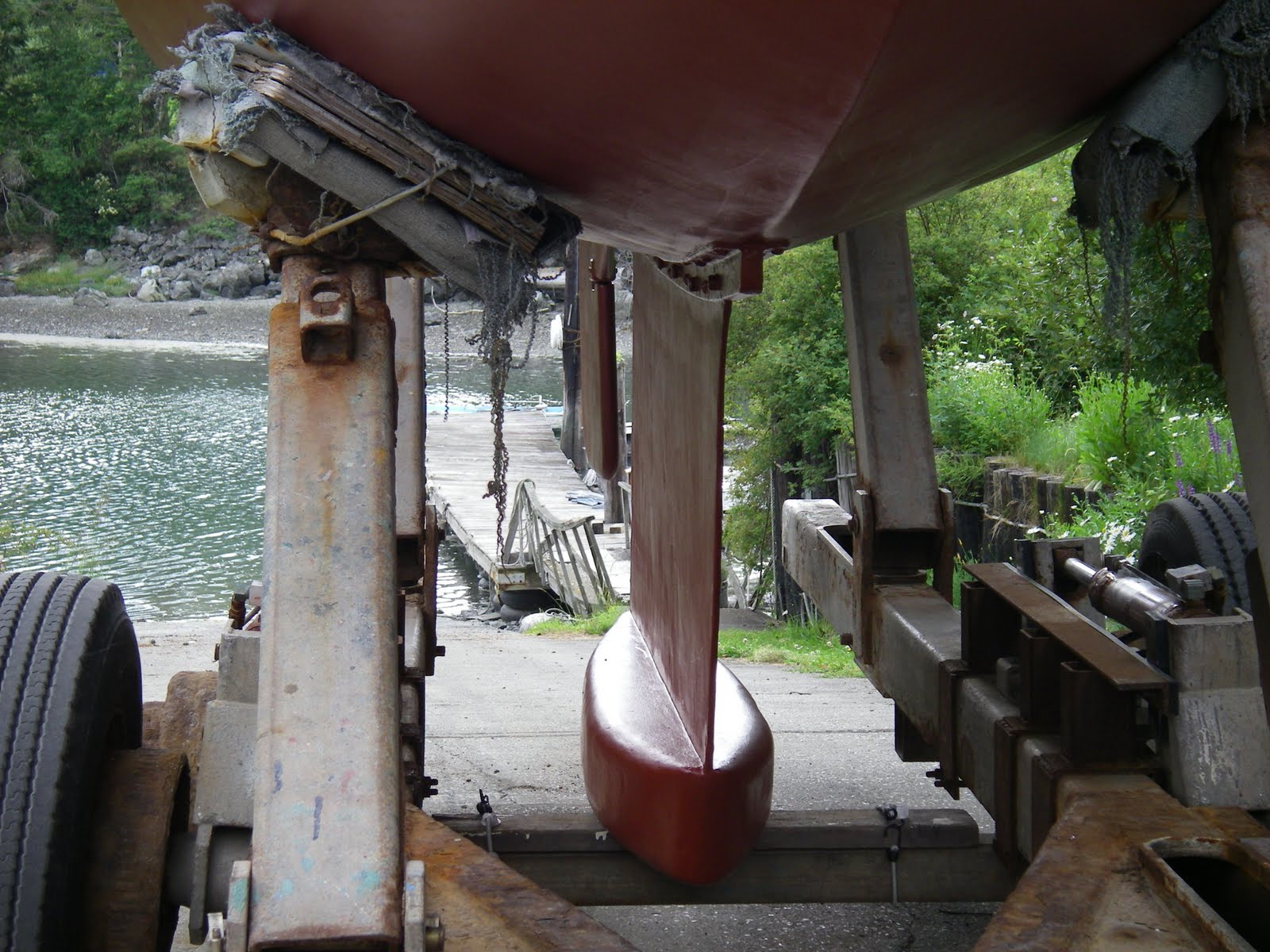
In July of 2010, I hauled TERN to give the keel, rudder and rudder shaft, and associated fasteners and hardware a thorough inspection. I also wanted to replace the transducer for the depth sounder as I replaced a rather old-school (and power-hungry) one with a new Garmin unit. While I was at it I applied two (and in some places three) coats of 66% copper antifouling, and re-designed the existing cockpit drain (which had always seemed vulnerable) such that it was more robust and allowed greater use of the large storage area under the cockpit sole.

The keel is fabricated out of 3/8"-1/2" galvanized mild steel, and is connected to two pieces of angle (one on either side of the keel plate) with a series of horizontal bolts. The angle pieces are, in turn, fastened vertically through the keel timber and floor timbers (both are of white oak) with stainless steel bolts. The streamlined lead ballast is 1000 lbs. and fastens with through-bolts to the keel plate.

This clever design allows the owner to remove the keel from the boat without removing any fasteners which would let water in. One intent of the design was to be able to put the boat (with keel removed) and keel on a flatbed trailer, negating the need for an expensive boat trailer.

The man I bought TERN from removed all the keel components and sandblasted, primed and epoxy-coated the plate, lead, and angle.  He also built a new rudder.  All hardware looked very good and trustworthy upon my inspection.


Sailing and Kayaking

Matt at Skookumchuck Rapids, B.C.
Matt, Shawna and Leon at secret spot
Loading the hatches of my sea kayak--the easy way!
My whitewater boat--the perfect stow-aboard tender
I came to paddling from my experiences and passion for sailing and the dream of owning my own salty vessel and embarking on an ocean passage or two.

To this day, I believe that kayaks (of various types) can be the ideal tender for a sail vessel. For exploration, efficiency, and fun they can't be beat. My one recommendation: choose appropriate, well-built craft.

Additional images of TERN

View aft--custom companionway ladder


Custom tiller, and adjustable tiller-lock
"Sardine" solid-fuel stove/heater

Cockpit showing new lexan companionway hatch and Ipea/yellow cedar cockpit sole

View fwd. port settee

Three beautiful girls: Djuna, Jen, TERN
Djuna at the helm, Oct. 2009
Stern view

A brief description of "TERN"


"TERN", a Laurent Giles-designed Columbia-class sloop is for sale. She is a sistership to John Guzzwell's "Trekka" which made a successful circumnavigation in the late 50's, except that "TERN" is sloop-rigged, and was launched in 1978.

L.O.A. 21'
L.W.L. 19'
Beam 6'

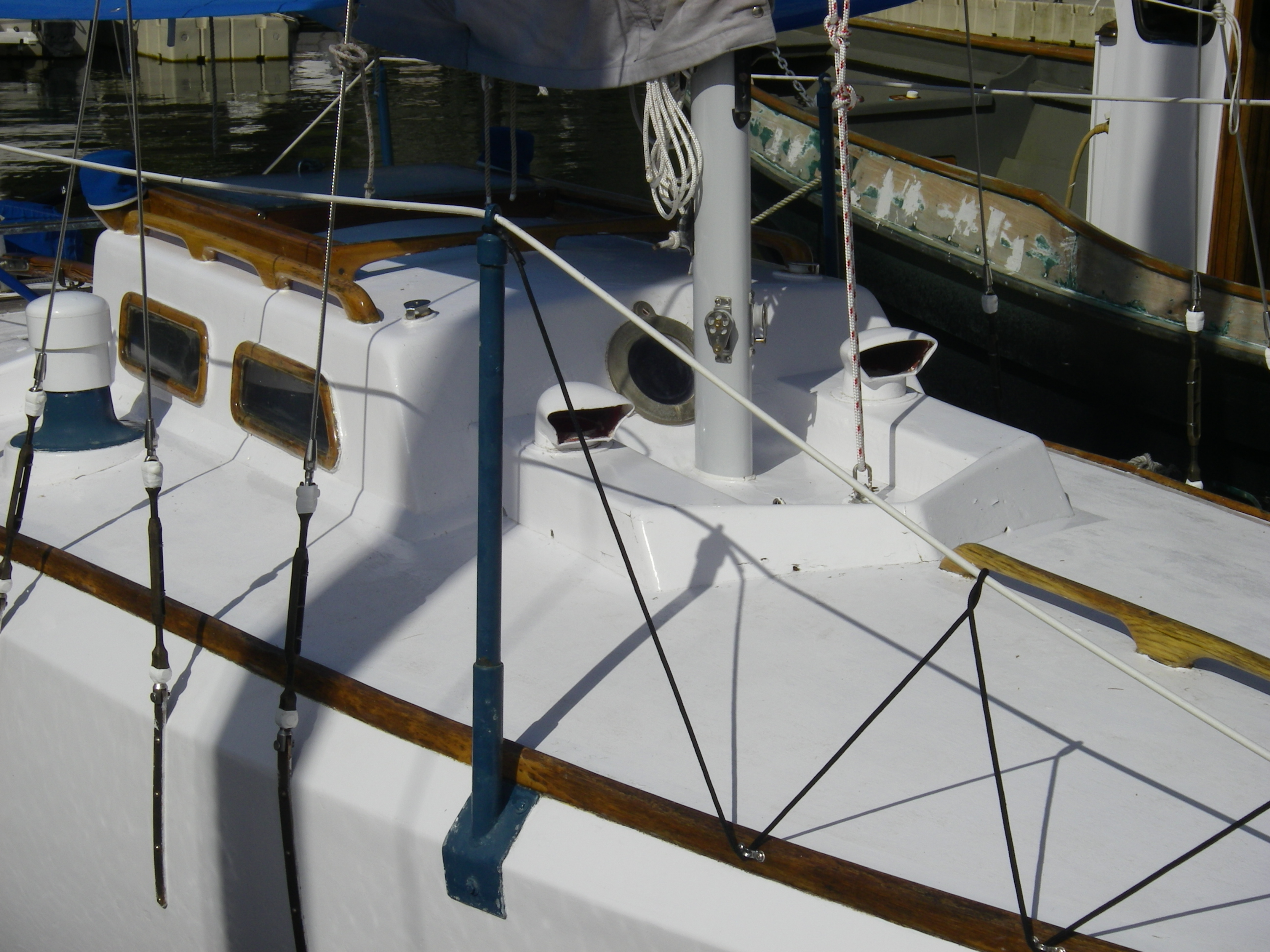
Construction: Port Orford yellow cedar edge-fastened (copper) and epoxied, then fastened (copper) on Oak frames. 1/2" marine-ply decks. 3/4" mahagony cabin house, cockpit coaming and dorade boxes. Entire hull, deck and cabin are covered in .5 oz. polypropylene cloth and epoxied (if you read Wooden Boat #119, July/Aug 1994, there is an article on sheathing wooden boats--the methods/materials used on TERN were the most ideal). Absolutely dry, incredibly healthy boat, I have not found any questionable wood inside or out. The entire hull is visible and accessible from the interior. Watertight bulkheads fore and aft.

Rig: All running rigging replaced 2009/2010. All standing rigging (7/32" stainless, 1x19) replaced spring 2010, all lower end terminals are Hayn Hi-mods. Bronze turnbuckles. Spar is aluminum, and was removed, stripped, re-painted with self-etching primer then 3 coats of Interlux Perfection. All hardware was removed, inspected, and re-bedded. New boom 2010.

I hauled the boat out in June 2010 and thoroughly inspected all rudder fittings, keel fastening system, and hull. All looked great. I also replaced the transducer, and then put 3 coats of antifouling on.

Sail inventory: Drifter (excellent), 150 mylar genoa (good cond.), 120 genoa (new 2010), working jib (excellent), smaller working jib (new), storm jib (never used), Spinnaker (fair-med.), current mainsail (very good-one reefing point), New mainsail 2010 (2 reefing points and reinforced hanks), light weight main for offshore (new 2010).

Other equipment:  Danforth 18lb. 250' of nylon rhode, 20' of chain (1/4"). 3 whisker poles, boat hook. Full boat cover. 5-h.p. Mercury outboard with 30 hrs. total. Inflatable dinghy. Depth sounder (new). Solar panel, Halyard winches, sheet winches. Compass on bridge deck.

Other assets: New custom tiller w/adjustable lock for singlehanding, New ipea/yellow cedar cockpit grates, New deck and cabinhouse paint Aug. 2010.

Interior: Two pilot berths forward, small traditional solid-fuel stove in galley area (stbd.), small chart table (port). Lots of storage for a small boat.  There is room belowdecks for two to sleep, cook and navigate--everything that must be done on an offshore voyage.

I acquired this boat with the idea of an offshore voyage, and have fitted "TERN" out to do just that. I have been in contact with the original builder as well, which has only added to my confidence in the boat. As I am also an avid kayaker and paddle sports coach, my plans have evolved to where a multi-hull might better serve me for my voyage, so am offering this capable boat for sale.

If you are interested in a well-proven boat that is simple, and easy to sail and maintain, which also has some class and worldwide reputation, TERN could be right for you.

TERN is being offered at $10, 300. 

Please, interested parties only... (360) 224-2079 or email: phoca74@hotmail.com